Farmhouse with Flowers
First Impression: Rustic Charm That Stops Booth Walkers in Their Tracks
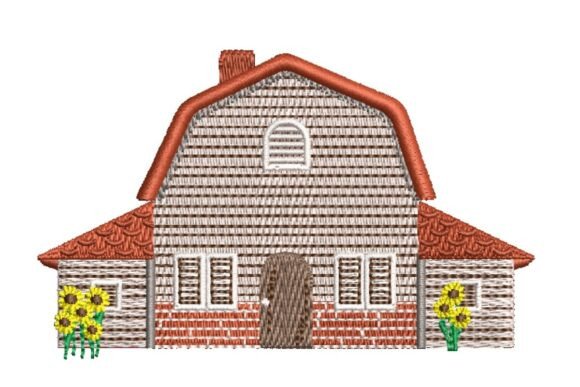
“Farmhouse with Flowers” lands exactly where it should — warm, grounded, and unmistakably Farm Country. It’s not fussy or overly vintage; it’s confident rustic. The phrase alone evokes brick chimneys, weathered wood siding, and sunflowers nodding in a soft breeze — all before you even see the machine embroidery design. That’s critical at a craft fair: customers make split-second decisions based on mood and memory. This design feels like comfort food for the eyes — familiar enough to resonate, detailed enough to feel handmade and intentional.
Where Farmhouse with Flowers Shines On Real Craft Fair Products
This embroidery file isn’t one-note. Its layered composition — brick texture, wood grain suggestion, and bold sunflower accents — gives it surprising versatility across product types:
- Tote bag design: Perfect centered on the front panel of natural canvas or oat linen. The scale reads clearly from three feet away, and the sunflowers add cheerful contrast against neutral fabric.
- Apron embroidery: Ideal above the pocket or along the bib edge. The brick-and-wood motif reads as artisanal, reinforcing the “made-by-hand” story shoppers seek.
- Tea towel embroidery: Works beautifully in the lower corner or centered mid-panel. Sunflowers pop against terry cloth — especially on cream, sage, or denim-dyed towels.
- Embroidered patch: Highly effective as a sew-on or iron-on accent for denim jackets, market bags, or kids’ backpacks. Customers love collecting themed patches — and this one invites storytelling.
- Pillow cover & small pouch: Holds clarity even at 4–5" wide. The sunflower’s face and petal definition remain legible, making it a strong small shop product for gift tables.
It’s less ideal on curved surfaces like caps — unless scaled down significantly and placed on the front panel (not the crown). Tiny lettering or fine brick lines may blur on dense knit caps without careful stabilizing.
What Makes Farmhouse with Flowers Sell — Beyond the Stitch
At a crowded handmade market, visual cohesion matters more than perfection. Farmhouse with Flowers delivers instant booth harmony: pair it with burlap tags, twine-wrapped jars, and chalkboard signage, and your display reads as intentional — not random. It elevates a plain tea towel into a handmade product worth $28 instead of $14. It makes an apron feel heirloom-worthy, not just functional.
For the Etsy seller, this design photographs exceptionally well. Sunflowers reflect light, brick textures add depth, and wood grain reads richly in natural lighting — no heavy editing needed. It also scales cleanly for printable mockups, helping buyers visualize it on multiple items before purchasing the digital embroidery file.
Production Reality Check: What You Must Test Before Batch Runs
Don’t skip the real-world test. As an embroidery designer who’s burned by assumptions, I’ll say it plainly: Farmhouse with Flowers has areas that demand attention:
- Dense stitch areas: Brickwork and sunflower centers often pack high stitch density. On textured towels or thick cotton duck, this can cause puckering — use cutaway stabilizer, not tear-away.
- Fabric texture matters: Avoid embroidering fine brick lines directly onto looped terry or heavily brushed flannel. The detail will vanish. Stick to smoother weaves for best clarity.
- Small-scale limitations: Below 3.5", the wood grain and mortar lines lose distinction. Use it as a focal design — not a subtle border or monogram accent.
- Dark fabric warning: Sunflower yellow thread must contrast sharply. Test your exact thread colors on black, navy, or charcoal fabric first — some golds turn muddy under low-light booth conditions.
Design Assets That Build Your Brand — Not Just Your Inventory
Farmhouse with Flowers isn’t just a craft fair product; it’s a brand anchor. When repeated across tote bags, aprons, and pillow covers, it creates consistency — something buyers subconsciously trust. It signals your shop lives in the Farm Country aesthetic lane, not hopping between themes. That consistency converts browsers into repeat buyers.
And for commercial embroidery sellers: confirm licensing terms *before* stitching on products for resale. This machine embroidery design is intended for finished goods — but always verify whether digitized variations, color swaps, or derivative designs require additional permissions.
Pro Designer Notes You’ll Thank Yourself For Later
Before cutting your first production run, do these six things:
- Test the embroidery file on scrap fabric matching your final product — same weight, weave, and pre-wash status.
- Check thread contrast under both daylight and warm booth lighting — what looks vibrant in your studio may dull under festival tent lights.
- Review spacing between brick rows and sunflower stems — tight gaps can collapse in dense stitching; adjust if needed for your machine’s tension.
- Confirm hoop size compatibility with your most-used hoops — don’t assume it fits standard 5x7 unless verified.
- Inspect stitch density in the sunflower center — if over 18,000 stitches, consider simplifying for faster turnaround and better fabric drape.
- Create at least one real-life mockup — photograph it on a shelf, hang it on a rack, hold it in hand. Does it look premium? Does it read at arm’s length? If not, tweak placement or scale.
Final Thought: A Design That Sells Because It Feels True
Farmhouse with Flowers succeeds because it doesn’t try to be everything. It leans fully into its roots — literally and aesthetically. That authenticity translates to buyer confidence. At a craft fair, people aren’t buying thread and stabilizer — they’re buying nostalgia, warmth, and intention. This embroidery design delivers all three. Whether stitched on a market bag or framed as a wall hanging, it carries the quiet authority of something made with care — and that, more than any stitch count, is what moves product off the table.